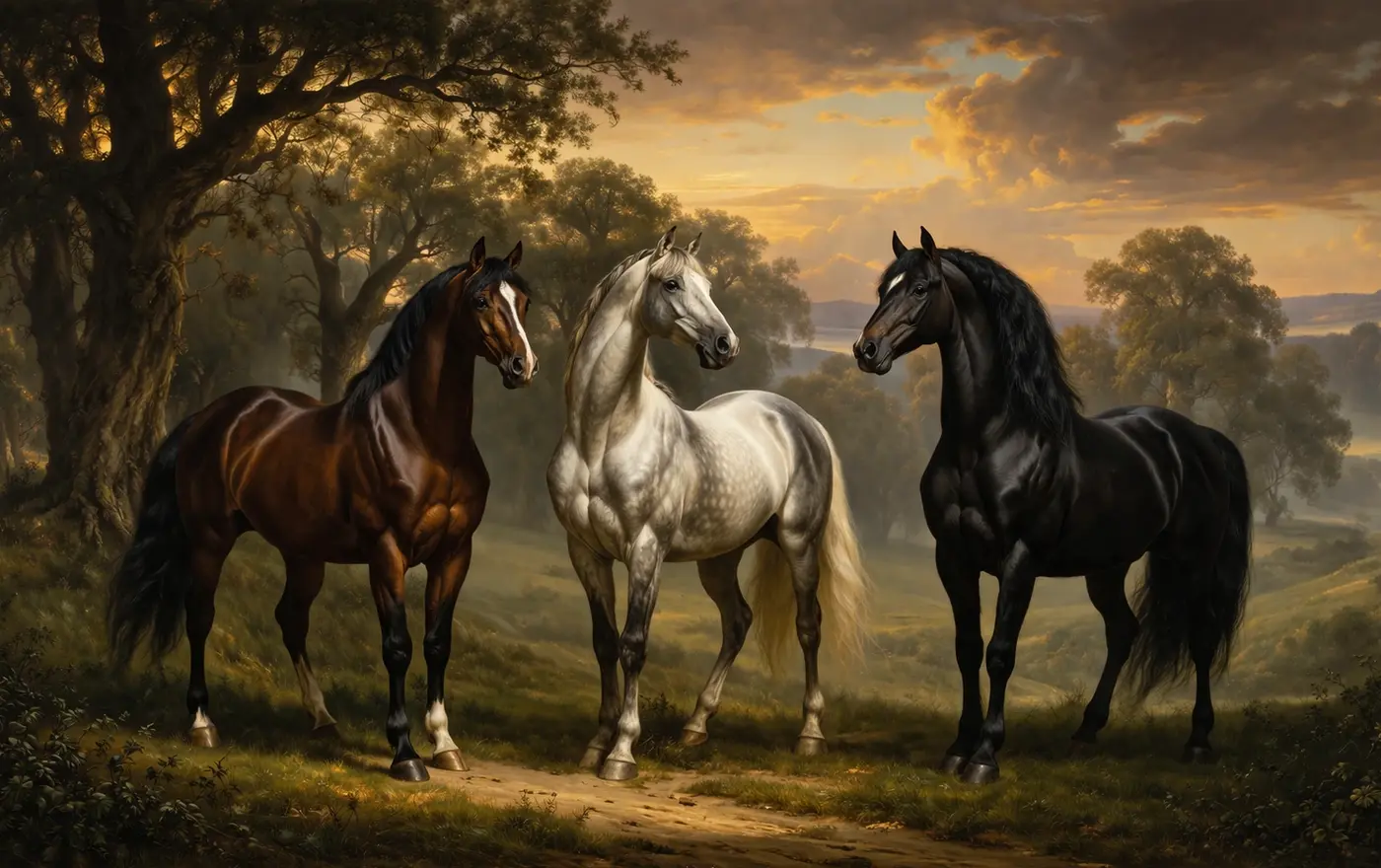
There is a fact about thoroughbred horses that, once heard, refuses to leave the mind. Every horse that has ever won the Kentucky Derby, the Epsom Derby, the Dubai World Cup, the Melbourne Cup, or the Japan Cup — every single one — is a direct patrilineal descendant of three stallions who died before the American colonies declared independence. Three horses. One breed. A bloodline now worth, conservatively, tens of billions of dollars. The geneticists confirmed it in 2005 with Y-chromosome analysis, but horsemen had suspected it for three centuries. Blood, as they say, will tell.
The story begins, as so many improbable English stories do, with a spot of imperial ambition and a great deal of luck. In the late seventeenth and early eighteenth centuries, English gentlemen had developed a ferocious enthusiasm for horse racing. Native stock was capable enough, but a rumour circulated — one that turned out to be entirely true — that the desert horses of the Arab world were something else altogether. Leaner, faster, built on springs. Three of these horses made the crossing. None of them could have imagined the consequence.
The Soldier's Horse
Captain Robert Byerley did not acquire his stallion through any genteel transaction at a bloodstock auction. He took him in battle. The year was 1686, the place was somewhere in the Ottoman campaign against the Habsburg siege of Buda, and the horse — a Turkish stallion of Arab or Turkoman breeding — was either captured from a Turkish officer or seized in the confusion of war, depending on which historian one consults. Captain Byerley, being a practical man, immediately put the horse to use.
He rode him at the Battle of the Boyne in 1690, where King William III's Protestant forces defeated the Catholic King James II. By all contemporary accounts, the Turk was the fastest horse on the field. The Captain survived; the horse survived; and in due course, when the excitement of revolution had subsided, the stallion was retired to stud in County Durham.
He was not merely a warhorse. He was, without anyone quite realising it at the time, the first instalment of a three-part revolution in horse breeding.
The Byerley Line: Herod and the Numbers Game
The Byerley Turk's most consequential contribution arrived generations downstream in the form of Herod (1758–1780). Herod was not especially celebrated as a racehorse, but as a sire he was catastrophically prolific — his descendants won 497 races in a single season. The Byerley line is the slenderest of the three today, nearly dying out entirely in the late nineteenth century, preserved largely through careful breeding in Germany and Hungary. The first Kentucky Derby winner, Diomed (1875), carried Byerley blood via Herod's descendant Florizel.
Byerley Male Line · Key Descent
Byerley Turk (c.1679) → Jigg → Partner → Herod (1758) → Florizel → Diomed — 1st Kentucky Derby Winner (1875)
The Merchant's Gamble
Thomas Darley was a merchant's son from Yorkshire who found himself in Aleppo in 1704 as part of his father's trading business. One day he encountered a bay colt of the Maneghi strain — a desert bloodline prized across the Arabian peninsula — and, with the confidence of a young Englishman abroad, wrote home asking his father to fund the purchase.
The Bedouin sheikh who owned the horse had, by some accounts, sold the colt without intending to actually part with him. Darley, undeterred, arranged for the colt to be removed by night. Whether this constitutes theft, creative commerce, or simple colonial-era improvisation remains a matter of historical interpretation. The horse arrived in Yorkshire in 1704. His son Flying Childers (1715) became the first horse in documented history to be universally described as simply "the fastest horse alive" — undefeated in every race he ran.
Flying Childers was the proof of concept. Eclipse was the proof of dominance. Between them, the Darley Arabian made the argument that has never since been refuted.
Eclipse: The Horse That Changed Everything
Flying Childers was extraordinary, but his great-great-grandson was history. Eclipse was born in 1764 during — according to legend — a solar eclipse. He raced for the first time at age five in 1769, won eighteen races in a row, and retired unbeaten. A contemporary observer recorded that his winning margins were so vast that by the end of his races the crowd had largely stopped watching. There was, apparently, nothing to see.
Eclipse sired 344 winners before his death in 1789. Modern genetic studies suggest that approximately 95% of all thoroughbreds in the world today carry Eclipse's Y-chromosome — meaning, in the direct male line, almost every thoroughbred alive is a descendant of Thomas Darley's audaciously acquired bay colt from Aleppo.
Darley Male Line · Key Descent
Darley Arabian (c.1700) → Flying Childers (1715) → Bartlett's Childers → Eclipse (1764) → Pot-8-Os → Waxy → Whalebone → Nearco → Northern Dancer → ~95% of all thoroughbreds today
The Horse They Found Pulling a Cart
The Godolphin Arabian has the most improbable origin story of the three, and in a field of improbable origin stories, that is saying something. He was bred in Yemen, sent as a gift from the Sultan of Morocco to King Louis XV of France, arrived at Versailles, and was — through some combination of French indifference and bureaucratic confusion — found some years later either pulling a water cart in the streets of Paris or in conditions of considerable neglect. Historians quibble over the details. The horse's experience of French hospitality was, by any account, suboptimal.
He was purchased by a Mr. Edward Coke, passed to the Earl of Godolphin, and settled at stud in Cambridgeshire around 1730. His initial role was as a "teaser" — the horse used to gauge a mare's readiness before the more celebrated stallion was introduced. Then came a mare called Roxana. Her assigned mate refused her. The Godolphin stepped in, and the result was Lath, then Cade, then — most consequentially — Regulus (1739). The underdog had, somewhat magnificently, refused to remain one.
From a Paris water cart to the foundation of a bloodline spanning every continent. There is, somewhere in this horse's biography, a metaphor that practically writes itself.
Matchem and the Godolphin Legacy
The Godolphin's most celebrated grandson was Matchem (1748), who won seventeen of his nineteen races and, alongside Herod and Eclipse, formed the triumvirate that dominated English racing in the 1760s–1790s. His line eventually produced West Australian (1850), the first horse to win the British Triple Crown. The Godolphin line today accounts for perhaps 3–4% of modern thoroughbreds, with notable concentration in European and Australian bloodstock.
Godolphin Male Line · Key Descent
Godolphin Arabian (c.1724) → Cade → Matchem (1748) → Conductor → Trumpator → West Australian (1850, first Triple Crown) → Blandford line → Europe & Australia
The Bloodline Goes Global: Six Racing Nations
The story of the three founding sires is, in its later chapters, a story about how a bloodline migrated across the world and adapted to every climate, track surface, and cultural context it encountered. The core genetic material remained the same. The horses became different things in different places.
The original home. Newmarket, Epsom, Ascot — the Classic pattern was established here. Frankel (2008–2013), unbeaten in all fourteen starts, is the highest-rated thoroughbred in Timeform history at 147. He is Darley-line, descending from Eclipse via Sadler's Wells.
American racing built its identity around speed. The first Kentucky Derby winner, Diomed (1875), carried Byerley blood. Secretariat (1973), still the fastest Kentucky Derby winner in history at 1:59.40, is Darley-line via Bold Ruler. Roughly 75% of modern thoroughbreds worldwide are Northern Dancer descendants.
The Godolphin operation — named, pointedly, for the third founding sire — is the world's most powerful racing and breeding empire. Dubai World Cup day at Meydan is the richest single race day in the world, with $30.5 million in prize money across twelve races.
The Saudi Cup (2020) is the world's richest individual race at $20 million. Saudi racing imports European Darley-line bloodstock at pace — Arabian-bred foundations returning to the Arabian peninsula as fully formed racing machines.
Deep Impact (2002–2019) was Japan's leading sire for eleven consecutive years and in 2019 became the world's leading sire by earnings — the first Japanese-based stallion to reach that position. Darley-line, Northern Dancer descent. Eclipse's blood, three centuries on, winning races in Tokyo.
Winx won 37 consecutive races between 2015 and 2019 — a world record for Group 1 wins (33). Darley-line via Danehill. The statistical probability of winning 37 consecutive races at elite level has been estimated at less than 1 in 10 billion.
The Champions Who Carried the Blood
Northern Dancer — The Sire That Remade the Industry
If Eclipse established the Darley line's dominance, Northern Dancer (1961–1990) industrialised it. A compact Canadian-bred bay, he won the 1964 Kentucky Derby in a then-record 2:00 flat. His stud fee reached $1 million per mare in the early 1980s. His sons — Nijinsky, Sadler's Wells, Danzig, Lyphard — each became foundation sires in their own right. Today, roughly 75% of the world's thoroughbreds are Northern Dancer descendants.
Secretariat — The Number That Has Never Been Beaten
Secretariat's 1973 Belmont Stakes win remains the most statistically extraordinary performance in American racing history: 31 lengths, 2:24 flat, a record that has stood for over fifty years. His heart, when examined post-mortem, weighed approximately 22 pounds — roughly three times the average thoroughbred heart. The racing community stopped debating the measurement. It simply calls it the answer.
Deep Impact — Japan's Contribution to the Canon
Deep Impact won the Japanese Triple Crown, then became the leading sire in Japan for eleven consecutive years. In 2019, the first Japanese-based stallion to be ranked the world's leading sire by earnings. He was Darley-line, Northern Dancer descent. Eclipse's chromosomes, setting records in Tokyo.
Winx — The Mare That Rewrote the Record Books
Winx won 37 consecutive races in Australia — a world record for Group 1 wins (33). Voted world's best racehorse four years running. Darley-line via Danehill, himself a Northern Dancer son. The statistical probability of 37 consecutive elite wins has been estimated at less than 1 in 10 billion. Winx managed it, then retired to an Australian farm, presumably satisfied.
What the Blood Means Now
The 2005 Y-chromosome study published in Animal Genetics confirmed formally what breeders had understood informally for two hundred years: all thoroughbred sire lines converge on three horses. The study also found something less expected. The mitochondrial DNA — the maternal line — is far more diverse. Dozens of founding mares contributed, their names largely unrecorded, their bloodlines flowing invisibly through every modern thoroughbred. The three stallions provided the patrilineal framework. The unrecorded mares gave the breed its depth.
Today the thoroughbred industry operates in approximately 60 countries with an estimated global economic value of $300 billion. The Saudi Cup carries $20 million; the Dubai World Cup $12 million; the Japan Cup $3.5 million; the Breeders' Cup Classic $6 million. Every horse in every one of these races carries, in the direct male line, the chromosomes of a Turkish warhorse, an Aleppo bay, or a cart-horse from Paris.
The Byerley Turk crossed a battlefield. The Darley Arabian crossed an ocean. The Godolphin Arabian crossed from obscurity to immortality. Together, they crossed into every racetrack on earth.
Pakistan and the Region
Pakistan's thoroughbred tradition draws directly from this same well. The horses racing at Lahore Race Club, Karachi, and Peshawar carry Darley-line bloodlines imported through the Anglo-Indian racing tradition and later supplemented by Gulf bloodstock. The racing horses bred and trained at establishments like Z-Stables in Lahore — three generations deep in equestrian knowledge since 1969 — are part of the same unbroken lineage that began when Thomas Darley arranged a somewhat irregular night-time transaction in Aleppo, sometime around 1704. The blood travels. It always has.