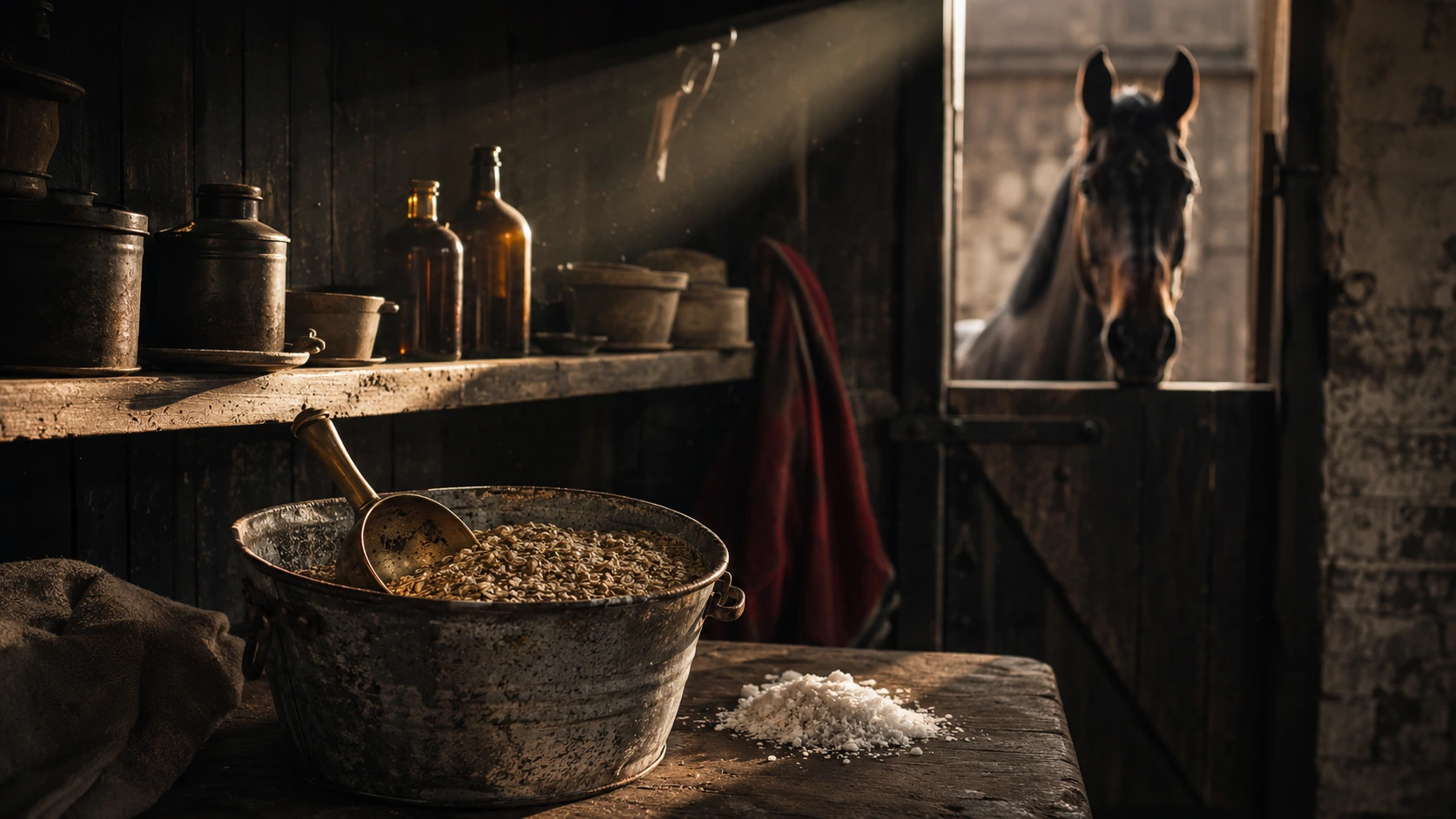
Walk into almost any feed room at Kot Lakhpat on a Tuesday morning and you will find, arranged on a shelf with the reverence normally reserved for family silver, somewhere between nine and fourteen open tubs. Two are electrolytes. Three are multivitamins, of which two contain the same twelve vitamins in the same order. One is an iron tonic, purchased because the horse "looked weak". One is a hoof supplement, opened four weeks ago and about to be abandoned as useless. And one — invariably — is a bottle nobody in the yard can identify, with a Russian label, given to the trainer by a friend, and administered to the entire string on Thursdays.
The bill for that shelf runs to a serious sum every month. The horse, meanwhile, is drinking from a bucket that was filled six hours ago, eating chokar weighed by eye, and has not had a gram of plain salt in a week.
This is the central and rather expensive comedy of Pakistani horse nutrition: we buy the top of the pyramid and neglect the base. Everything that follows is an attempt to put the pyramid back the right way up — category by category, brand by brand, with the numbers attached.
The Rule That Comes Before Every Other Rule
A supplement is not an engine. It is an insurance policy. It does not create performance; it removes the small, invisible tax that a deficiency levies on performance the horse already has. This distinction sounds academic until you watch a man spend a hundred thousand rupees a month on tubs while feeding hay he has never once weighed.
The hierarchy is not negotiable and it runs in exactly this order: water, then forage, then energy, then protein quality, then the micronutrients, and only then the clever stuff in tubs. A horse denied water for a day loses more performance than every supplement in this article could return in a month. A horse on 4 kg of poor hay cannot be rescued by a scoop of vitamins. Get the base right and the supplements do what they are meant to do — close the last five per cent of the gap. Get the base wrong and the supplements are a form of prayer with a receipt.
The most under-used supplement in Pakistan costs eighty rupees a kilo and is sitting in your kitchen. It is called salt.
The First Principle of Feed-Room EconomicsTwo Different Athletes, Two Different Bills
Before a single product is named, it is worth being precise about who is eating it, because the race horse and the polo pony are not the same animal doing different jobs — they are different jobs demanding different animals.
A race horse performs once. A mile at Lahore is roughly a hundred seconds of near-total effort, drawing heavily on stored muscle glycogen and on anaerobic pathways that flood the muscle with lactate. Its year is built around a handful of such efforts, separated by weeks. What it needs from nutrition is a full glycogen tank, an intact gut, and an electrolyte balance sound enough to survive one enormous sweat.
A polo pony performs again, and again, and again. Seven and a half minutes of stop-start galloping, turning, and bumping — then, in many strings, another chukka later the same afternoon, and another match on Sunday. The efforts are shorter but the cumulative sweat loss across a match is often greater than a racehorse's on race day, and the concussive load on the limb is in another league entirely. What the polo pony needs is recovery: rehydration between chukkas, joint and tendon support, and hoof integrity strong enough to survive a season of ninety-degree turns on ground that in a Lahore May is roughly the consistency of a cricket pitch.
| Category | Race Horse | Polo Pony |
| Effort | One maximal sprint, 60–150 sec | Repeated bursts across 7.5-min chukkas |
| Electrolytes | Critical around race day and fast work | Critical daily in season; between chukkas |
| Energy | Glycogen loading; starch matters | Sustained energy; more fat and fibre |
| Gut | High grain, high stress, high ulcer risk | Travel and match-day stress; ulcer risk |
| Joints & Limbs | Concussion on the straight | Torsion, turning, contact — far higher load |
| Hoof | Thin aluminium plate, light and fast | Steel, grip, and a wall that must hold nails |
Electrolytes: The Only Emergency
Of everything in this article, this is the one category where getting it wrong can kill a horse in an afternoon, and where getting it right is nearly free.
Horses are the sweatiest athletes on earth. In hard work in Lahore heat, a horse can lose 10 to 15 litres of sweat in an hour. Worse — and this is the part that catches people out — horse sweat is hypertonic. Human sweat is more dilute than blood; you lose mostly water and can drink water to fix it. Horse sweat is saltier than the horse's own blood. A sweating horse loses proportionally more salt than water, which means the classic mistake — giving only water after work — dilutes what little salt is left, switches off the thirst reflex, and leaves a horse that is simultaneously dehydrated and refusing to drink.
Read that chart again and a strategy falls out of it on its own. Sodium and chloride are the bulk of the loss, and sodium chloride is table salt. 30 to 60 grams of plain salt daily in the feed — one to two tablespoons — is the cheapest performance intervention available to any yard in Pakistan. The commercial electrolyte is not a replacement for that; it is the top-up for the potassium, calcium and magnesium, and the vehicle for getting salts into a horse fast on a hot day.
How to Actually Use Them
Give electrolytes before and after hard work and racing, never on an empty stomach, and never — this is the one non-negotiable — without free access to water. A concentrated electrolyte dose into a horse with no water pulls fluid from the bloodstream into the gut and makes dehydration worse. Pastes are for travel and race day; powders in the feed are for the daily grind. And if a horse in heavy summer work is doing well on electrolytes, that is not evidence that four scoops would be better.
| Brand | Product | Form & Use |
| Farnam | Apple Elite Electrolyte | Palatable powder — daily through the hot months |
| Farnam | Electro Dex | Powder with dextrose — feed or water, post-work |
| TRM | Electrolyte Gold | Powder tub or 50g single-dose sachets — one sachet replaces roughly an hour's sweat |
| Ranvet | Salkavite | Powder — electrolytes plus B-group vitamins; feed, water, or pre-race drench |
| NAF | Electro Salts | Powder — measured daily replacement |
| LPC | Quick Lyte | Concentrated powder (1 kg tub); also as Quick Lyte Flash oral syringe for race day and travel |
Multivitamins: The Insurance Premium
Here is the case for the multivitamin, and it is entirely a Pakistani case. A horse that lives on pasture in Ireland gets vitamin E, beta-carotene and a good deal else from fresh green grass. Our horse lives in a box at Kot Lakhpat, works at dawn, and eats oats, barley, bran, gram, and hay that has been sitting in a store for months. Vitamin E and beta-carotene degrade steadily in stored forage. The stabled Pakistani racehorse is, almost by design, a horse with no fresh pasture in its diet.
That is what a broad-spectrum multivitamin is for: not a boost, but a floor. It guarantees the B-complex the horse needs to convert feed into energy, the trace minerals — copper, zinc, manganese, selenium — that Punjab soils and Punjab fodder are frequently short of, and the fat-soluble vitamins that stored feed has quietly lost. One product. Once daily. Chosen and then left alone.
One local wrinkle worth knowing: Ranvet splits its Folactin line by job rather than by price. Folactin Blue is the racing and training formula — minerals for the horse in work. Folactin Red and Red Plus are the breeding formulas, for broodmares, foals, weanlings and yearlings, and they carry added copper, which is precisely why you switch a horse to Blue once it goes into training rather than feeding both.
The single most common error in this category is buying two of them. An owner uses one brand's multivitamin because the trainer recommended it, then adds another because a friend at the club swears by it. The two products are, in nutritional terms, 80 to 90 per cent identical. He is now paying twice for the same twelve vitamins and — with vitamins A, D, E and selenium, which the body stores rather than excretes — creeping towards genuine excess. Pick one. Feed it properly. Move on.
| Brand | Product | Form & Use |
| Vita Flex | Accel | Daily vitamin/mineral base with antioxidants |
| Vita Flex | Accel Lifetime | Broader spectrum — older horses, long campaigns |
| Farnam | Vita Plus | Balanced daily multi-vitamin and mineral, pelleted |
| Ranvet | Folactin Blue | Racing formula — minerals for horses in work and training |
| Ranvet | Folactin Red | Breeding formula — broodmares, foals, weanlings, yearlings |
| Ranvet | Folactin Red Plus | Breeding formula, fortified — mares, young stock, older horses |
| TRM | Calphormin | Pelleted minerals plus lysine — bone and skeletal development in young stock and in-foal mares |
| NAF | Five Star Optimum | Concentrated pelleted balancer — vitamins, minerals and gut biotics in one |
Iron: The Most Expensive Myth in Pakistani Racing
Now we come to the tonic bottle, and to a belief so entrenched in this country that arguing against it feels faintly heretical. A horse runs badly. Somebody looks at it, declares that khoon ki kami hai, and an iron tonic appears. In severe cases, an injection appears. The horse improves, or doesn't, and either way the belief survives.
The evidence says something uncomfortable. True iron-deficiency anaemia in an adult horse in work is close to non-existent. Horses are not people. They do not menstruate. Their forage and grain already carry iron far in excess of requirement — ordinary hay and grain routinely deliver several times the daily need before anyone opens a bottle. Meanwhile, the horse has no efficient way to excrete surplus iron: it stores it, in the liver, indefinitely. Chronic over-supplementation is associated with liver iron loading, oxidative stress, and — the practical sting — interference with the absorption of copper and zinc, the very minerals that build strong hoof and connective tissue. The iron tonic bought to make the horse stronger can quietly work against the hoof supplement bought to make the foot stronger.
There is also a physiological joke at the heart of the whole business. The horse has a spleen that stores an enormous reserve of red cells and dumps them into circulation the moment it gallops. A blood sample taken at rest can look unremarkable, and the same horse can raise its packed cell volume dramatically within seconds of exercise. Judging a racehorse's "blood" by how it looks in the box is like judging an engine by the sound of the ignition.
If you think the horse has a blood problem, buy a blood test. It costs less than a season of tonics, and unlike the tonic, it tells you the truth.
On Diagnosis Before TreatmentThis does not mean iron products have no place — it means they have a narrow place. The useful members of this category are rarely useful because of the iron; they are useful because of the copper, B12, folate and cobalt travelling with it, which genuinely do support red-cell production, and because a horse recovering from a real blood loss or a genuinely diagnosed deficiency needs the whole package. Use them on a diagnosis, on a course, and then stop.
| Brand | Product | Form & Use |
| Farnam | Red Cell | Liquid or pelleted iron, copper and vitamin tonic — short courses |
| Farnam | Redglo | Liquid multi-vitamin with iron and minerals — condition and appetite |
| TRM | IronXcell | Iron-enriched B-vitamin syrup — red-cell synthesis and metabolism |
| Ranvet | Hemoplex | Iron and B-group tonic — recovery and appetite |
| LPC | Red Booster | Powder (1 kg tub) — iron, copper, zinc, B12 with vitamin E and selenium; also as Red Booster Flash syringe |
Vitamin E & Selenium: The Muscle Insurance
If the iron tonic is the most over-used product in Pakistani racing, vitamin E is comfortably the most under-used — and the two facts are related, because the horse that "ties up" on a Sunday morning is not short of iron.
Every stride a galloping horse takes generates free radicals inside the muscle cell. Vitamin E and selenium are the two nutrients that mop them up — a pair, working in tandem, one inside the membrane and one inside the enzyme. Take them away and the muscle cell membrane becomes fragile. The visible result is the syndrome every Pakistani trainer knows and dreads: the horse that comes back from work stiff, sweating, reluctant to move, with dark urine. Tying up. Azoturia. Monday morning disease. It has several causes, but low vitamin E and selenium status sit near the top of the modifiable list.
The numbers are these: a horse in training generally needs somewhere in the region of 1,000 to 2,000 IU of vitamin E per day — far more than stored hay in a Lahore godown will ever supply — and roughly 1 to 3 mg of selenium daily. Two details matter. First, natural-source vitamin E (RRR-alpha-tocopherol) is roughly twice as bioavailable as the synthetic form, so read the label, not just the IU number. Second, selenium is the one mineral in this entire article with a narrow safety margin. The gap between an effective dose and a toxic one is not large. Feeding two selenium-containing products at once — a multivitamin plus a dedicated E/Se supplement, say — is exactly how a well-meaning owner walks a horse into selenium excess. One source. Count it. Never stack.
| Brand | Product | Form & Use |
| TRM | Selenavite E | Powder — vitamin E, selenium and antioxidants |
| Farnam | Vita E & Selenium | Crumbles — muscle and cell membrane support |
| LPC | Red Booster | Carries vitamin E and selenium alongside its iron — count it as a selenium source |
Hoof Food: The Slowest Purchase in the Feed Room
Nothing in the tub cupboard tests an owner's patience like a hoof supplement, and nothing is abandoned earlier or more often.
The arithmetic is unforgiving. A hoof wall grows down from the coronet at roughly 6 to 10 millimetres a month. A racing thoroughbred's hoof capsule is somewhere around 80 to 100 millimetres from coronet to ground. Do the division. It takes nine to twelve months to grow an entirely new foot. When an owner starts a biotin supplement in March and declares it useless in May, he has not tested the product. He has tested his own attention span. The new horn produced during those eight weeks is still three-quarters of the way up the wall, invisible, doing nothing yet.
The evidence for the actives themselves is unusually good by supplement standards. Biotin at 15 to 20 mg per day, fed continuously for six to nine months, measurably improves horn growth rate and hardness in horses with poor feet. It works with company: methionine (the sulphur-bearing amino acid that builds the keratin cross-links), zinc, and copper. A hoof supplement without those is a biotin bottle with a nice label.
One warning that costs Pakistani owners real money: check the biotin dose per serving, not per kilogram of tub. A great many cheap products contain 2 to 5 mg per scoop. At that rate you would need four scoops to reach the clinically studied dose, and you are still paying for the packaging. And read the Owner's Guide to Farriery before you spend a rupee on horn — because a foot that is being trimmed and shod badly cannot be rescued by anything you pour into a bucket.
| Brand | Product | Form & Use |
| Farnam | Horseshoer's Secret | Pelleted biotin, methionine and zinc — the long-course standard |
| TRM | Hoofmaker | Concentrated biotin pellets with methionine and trace minerals |
| NAF | Bio-Bloom PSB | Biotin with methionine and MSM — brittle, crumbling horn |
| NAF | Profeet | Hoof-focused feed supplement for long courses |
| Diamond | Hoof Biotin | Biotin with vitamins and trace elements — hoof, coat and skin |
| Diamond | Hoof & Horse Formula | Broader complementary feed — amino acids, omega-3, minerals for horn quality |
Amino Acids: Why "Protein %" Is a Lie
Ask a Pakistani trainer about protein and he will tell you the percentage in the feed. Ask him which amino acid is limiting and the conversation ends. This is the single most underrated gap in local horse nutrition, and it hides behind a number everybody trusts.
A horse does not build muscle from "protein". It builds muscle from twenty-odd amino acids, and — like a builder short of one size of brick — it can only build as far as the scarcest one allows. That scarcest one, in almost every diet on earth, is lysine. Then methionine. Then threonine. This is why a feed can be 14 per cent crude protein and still produce a horse that will not muscle up: the protein is there, but the lysine ran out first, and the rest of it was burned for energy or excreted as urea — which is also, incidentally, why an overfed, badly balanced box smells so strongly of ammonia.
Our staple ingredients make this worse rather than better. Oats, barley, maize and bran are all comparatively poor lysine sources. Gram (chana) is better, and soya bean meal is better still — it is, in practical terms, the single cheapest lysine intervention available to a Lahore yard. A 500 kg horse in serious training needs on the order of 40 grams of lysine a day, and the difference between a diet that supplies it and a diet that does not is exactly the difference between a horse that fills out over a season and one that just looks fit and slightly hollow.
| Brand | Product | Form & Use |
| Soya bean meal | (feed ingredient) | The cheapest lysine in Pakistan — 200–400 g daily transforms a lysine-poor ration |
| TRM | Calphormin | Declares its lysine on the label — soya amino acids plus L-lysine, in a pellet |
| Diamond | Hoof & Horse Formula | Amino acids and omega-3 alongside the hoof minerals |
| Farnam | Weight Builder | Fat-based calories for horses that will not hold flesh |
The Racing Formulas: Everything Else in the Cupboard
Beyond the six classical categories sits a heap of products that resist neat filing — the calmers, the gut supplements, the joint powders, the recovery formulas, the condition oils. They are worth understanding as a group, because they share a single characteristic: they are attempts to fix a problem that training has created.
Gut and Ulcer Support
This is not an optional extra; it is arguably the most evidence-backed category on the shelf. Studies scoping thoroughbreds in active training consistently find gastric ulceration in the region of 80 to 90 per cent of horses. The mechanism is not mysterious: high grain, low forage, long empty stretches, and the physical sloshing of stomach acid onto the unprotected upper stomach during a gallop. A horse with ulcers eats less, holds less condition, is sour in the box, and runs below itself. Buffers, pectin-lecithin complexes, and yeast-based hindgut supports genuinely help — but the cheapest intervention remains a scoop of chaff or a small hay net before fast work, so the acid has something to splash into other than the stomach wall.
Calmers
Magnesium and tryptophan formulas take the edge off a horse that is nervous rather than fresh. The distinction matters: a horse that is fresh needs work, not a calmer. A horse that is genuinely anxious — in the stalls, on the walk to the gate — may benefit. But note the rule that governs this entire end of the shelf: a product that is perfectly legal in a feed room can be perfectly illegal in a horse's bloodstream on a Sunday afternoon at Lahore Race Club. Know the withdrawal times. The stewards do not accept "a friend gave it to me" as a defence, and nor should they.
Joints, Recovery and Condition
For the polo string in particular, joint support is not a luxury item — a pony playing chukkas through a season absorbs torsional load that a racehorse simply never meets. Recovery formulas and condition oils sit in the same bracket: unglamorous, slow, and the difference between a horse that lasts a campaign and one that does not.
You will notice that this is the one section of this article with no table under it, and the omission is deliberate. Every product at this end of the shelf is a solution waiting for a diagnosed problem. A joint supplement belongs in the bucket of the pony that is stiff on the second day of a tournament — not in the bucket of every horse in the yard because a tub happened to be on the shelf. A calmer belongs to the horse that is anxious, not the horse that is under-worked. A gut supplement belongs to the horse that has been scoped, or to the one whose management makes ulcers inevitable. Name the problem first; buy second. Never the other way around — and never two of them at once, which is the same mistake as two multivitamins, wearing a more expensive hat.
That is also why we will not list this category brand by brand. Tell us the horse, the work it is doing, and the thing it is actually doing wrong, and we will tell you which product fits — including, more often than you would expect, that none of them do, and that the answer is a change to the ration or the training week rather than a purchase.
Outside the Bucket: The Care Shelf
Everything so far goes in at the mouth. What follows goes on at the leg and the foot — and in a racing yard, the leg is where the money is lost. A horse does not usually stop racing because of what it ate. It stops racing because a tendon went, or a shin got sore, or a foot fell apart in the monsoon.
Poultices: The Draw
A poultice is a clay — usually kaolin, usually with glycerine, often with boric acid or tea tree — applied to a leg after hard work, covered with damp paper and bandaged overnight. Cold clay does two things: it pulls heat out of a limb that has just absorbed several tonnes of concussion, and the drying clay itself has a mild drawing action on inflammation. This is the single most useful hour of work a groom does after a fast gallop. Applied hot rather than cold, and packed into a foot rather than a leg, the same principle draws an abscess — the treatment that has saved more feet in Pakistan than any medicine in a bottle.
Liniments, Braces and Gels: The Wash
Menthol, camphor, arnica, witch hazel. A liniment brace is rubbed into the legs and back after washing; it stimulates superficial circulation, cools by evaporation, and — not to be sneered at — enforces the fifteen minutes of hands-on contact during which a good groom finds the heat and the filling that nobody has noticed yet. Gels are the targeted version, for tendons and shins. One rule: do not bandage over a liniment unless the label explicitly says you may. A counterirritant trapped under a wrap on a warm Lahore night is how you blister a horse's leg by kindness.
Hoof Topicals: The Moisture Problem
Here is the thing almost nobody in the yard understands, and it explains why hoof oil is both over-used and under-used in the same stable in the same year. Hoof oil does not feed the hoof. It regulates the hoof's exchange of water with the outside world. That is all it does. And that means the correct product is a function of the calendar.
In a Lahore May, with ambient humidity in the twenties, the hoof loses water to the air, the wall shrinks and cracks, nails loosen, and shoes are thrown. The answer is a sealing product — an oil, a grease, a dressing that slows evaporation — plus a moisturiser or conditioner at the coronet where new horn is forming. In August, with the monsoon standing in the box and the wash bay never quite dry, the problem inverts completely: the foot takes on water, the sole goes spongy, the wall softens, thrush colonises the frog, and the same nails now tear out of horn with the structural integrity of wet cardboard. The answer then is a hardener — the pedocine-type astringent dressings — and dry standing, and a clean box.
Use a moisturiser in the monsoon and you are helping the foot rot. Use a hardener in a dry June on a foot that is already brittle and you will crack the wall. The product is not "good" or "bad". It is timely or it is wrong.
The Diamond range is worth a note here, because it comes out of the same Dutch house as the shoes: Diamond Hoofcare is a Kerckhaert brand, which means the people making the oil and the people making the plate are working on the same foot from opposite ends. Oil and grease for the dry, Hoof Defender and Frog Dressing for the wet, Hoof Conditioner for horn that has gone brittle — and the Hoof Biotin and Hoof & Horse Formula in the bucket, feeding the wall that all of it sits on.
| Brand | Product | When to Use |
| Farnam | Icetight | Cold clay after fast work — draws heat and filling from the leg |
| Vita Flex | Uptite | Overnight cooling poultice — race and gallop days |
| LPC | Muscle Eze | Tonifying clay wrap — muscles and legs after hard work |
| Brand | Product | When to Use |
| Farnam | Vetrolin Liniment | Brace after washing — circulation, cooling, and the fifteen minutes of hands-on inspection that finds tomorrow's problem today |
| Farnam | Thermaflex Liniment Gel | Menthol and MSM gel — flash cooling then deep warmth; needs no wrap |
| Farnam | Vetrolin Bath | Wash-down for the whole horse after work |
| LPC | Tendonil | Massage gel for tendons and shins |
| Brand | Product | When to Use |
| Diamond | Hoof Oil | Dry months — slows evaporation from the wall |
| Diamond | Hoof Grease | Heavier daily seal for hoof and coronet band |
| Diamond | Hoof Conditioner | Protein-based dressing — rebuilds and holds moisture balance |
| Diamond | Hoof Defender | Antibacterial and antifungal protectant — wall, sole and frog |
| Diamond | Frog Dressing | Blue gel over the frog; when the colour fades, reapply |
| Farnam | Rain Maker | Dry-season conditioning at coronet and wall |
| Farnam | Horseshoer's Secret Hoof Conditioner | Deep-penetrating dressing for brittle horn |
| Local | Pedocine-type hardener | Monsoon only — soft soles, weak walls, lost shoes |
Where Nutrition Ends and the Shoe Begins
A hoof supplement fed for nine months, a hoof oil applied in the right season, and a foot that is then nailed badly is nine months and a great deal of money burnt. Nutrition builds the horn. Farriery decides what happens to it. And on a Pakistani racecourse — hard ground, tight turns, and in polo, torsional forces that would frighten a structural engineer — the shoe is not an accessory. It is the interface between everything you have paid for and the ground.
For racing and for polo, we have never seen a reason to look past Kerckhaert — the Royal Kerckhaert Horseshoe Factory of Vogelwaarde, in the Netherlands, founded in 1906 and now the largest independent horseshoe manufacturer in the world. For the race horse, the Kings Plate aluminium range: the Extra Sound and the Super Sound, the shoes our own Chasing Eden races in, and the subject of a longer argument in Kings Plate Aluminium. For polo, the Kings High Goal — rubber-and-steel, built for grip and for the stop-turn violence of a chukka on hard ground, which is a different problem from the one a racing plate solves, as anyone who has watched a pony pivot at speed in a Lahore tournament will understand.
The full Kerckhaert range and specifications are published by the factory itself at kerckhaert.com. Z-Stables is Pakistan's exclusive Kerckhaert distributor.
The Mistakes: A Field Guide
We have now audited the shelf. What remains is to audit the owner — because after fifty-seven years of watching feed rooms in this city, we can report that the errors are astonishingly consistent, and that almost all of them are errors of enthusiasm rather than neglect.
Mistake One: Buying Two of the Same Thing
The most expensive habit in Pakistani racing. An owner buys a multivitamin from one brand and a multivitamin from another, an electrolyte from a third and an electrolyte from a fourth, because each was recommended by someone he respects. He believes he is being thorough. He is being taxed. Within a category, the products are 80 to 90 per cent the same molecule doing the same job. There is a premium tier and a value tier and there is a genuine difference in palatability, purity, carrier quality and consistency between them — but there is no difference at all in what biotin is, or what sodium chloride is.
Pick one brand per category. Feed it at the label dose. Pay attention for three months. Then judge it. Two brands in one category do not double the benefit — they double the invoice, and with the fat-soluble vitamins and selenium, they can genuinely double the dose of the one thing you did not want doubled.
Mistake Two: The Overdose of Love
"If one scoop is good, three will be excellent." This is the logic of a man who has never read a toxicity table. Vitamins A, D and E, along with selenium and iron, are stored, not excreted. Selenium in particular has a genuinely narrow safety window. Over-supplementation is not merely wasteful — with these five, it is a slow, invisible harm being administered daily by an owner who loves his horse very much.
Mistake Three: The Taseer
And now, respectfully but firmly, to the belief that governs more Pakistani feed decisions than any nutritional textbook: that feeds possess an intrinsic garam or thanda taseer — a heating or cooling nature. Barley is cooling. Gram is heating. Maize is heating. Bran is cooling. Eggs are heating. Do not feed X in June.
There is no such property. Not in physics, not in physiology, not in any measurement anyone has ever been able to make of a feedstuff. A grain has a temperature, a moisture content, a digestible energy value, a starch fraction, and a protein profile — and that is the complete list of things it possesses.
But — and this is why the belief has survived so long — the observation underneath it is real. Feed a horse maize and it becomes hot and unmanageable within a week. That is genuinely what happens. It is simply not taseer. It is calories. Maize is one of the most energy-dense grains in the store; it delivers a large load of rapidly fermentable starch, and a horse given more digestible energy than its work is burning will convert the surplus into exactly the behaviour every trainer has observed — fizzing, jogging, sweating, pulling. The horse is not "heated". The horse is over-fuelled and under-worked. Cut the maize and the horse settles, and the trainer concludes that maize is garam, and the myth is confirmed for another generation.
The reframing costs nothing and changes everything. It is not taseer, it is energy in versus energy out. And once you think in those terms, you can actually solve the problem: you can substitute fibre and oil for starch, you can match the ration to the work, you can feed the same grain to a horse in hard training and a horse on a break and expect very different behaviour. A system based on taseer cannot do any of that, because it is not measuring anything. It is only remembering.
- Water first. Clean, cool, unlimited. Everything else is decoration if this is wrong.
- Salt daily. 30–60 g of plain salt in the feed. The cheapest thing you will ever buy for a horse.
- Weigh the feed. Not scoops. Not andaza. A kitchen scale costs less than one tub.
- One brand per category. Two multivitamins is not twice the vitamins. It is twice the bill.
- Count your selenium. Add up every product that contains it. Only one should.
- Diagnose before you dose. A blood test before an iron tonic. Always.
- Give the hoof nine months. Not nine weeks. It cannot physically show you sooner.
- Forage before fast work. A small feed of chaff protects the stomach from its own acid.
- Hardener in the wet, oil in the dry. Never the other way around.
- Know the withdrawal times. The stewards do not care who gave you the bottle.
The Horse Does Not Read the Label
Here is the pattern that runs through every one of these mistakes, and it is worth naming plainly, because once you see it you cannot unsee it in any feed room in the country.
Every error above is an error of substitution — substituting the thing that is easy to buy for the thing that is hard to do. It is easier to buy an iron tonic than to book a blood test. It is easier to buy a second multivitamin than to read the label on the first. It is easier to buy a calmer than to give a fresh horse another twenty minutes of canter. It is easier to believe in taseer than to weigh a ration. The shelf, in the end, is not really a nutrition programme. It is a very expensive way of avoiding a scale, a bucket, a stethoscope, and a stopwatch.
Get those four right and the tubs will do their proper work, which is small, unglamorous and genuinely valuable: closing the last five per cent. And on a Sunday at Kot Lakhpat, five per cent is roughly the width of a neck at the post.
Z-Stables is Pakistan's exclusive distributor for Kerckhaert of the Netherlands, and for Diamond Hoofcare, and stocks Farnam and Vita Flex (USA), TRM (Ireland), Ranvet (Australia), NAF (United Kingdom) and LPC (France) from Model Town, Lahore. We race what we sell and we feed what we recommend. If you want a ration audited rather than a tub sold to you, call us — the advice is free, and it will usually save you money.