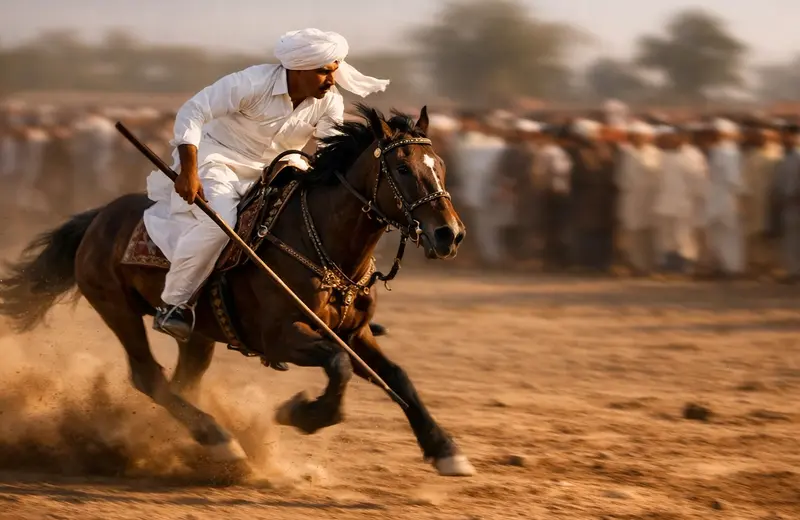
The Sport
Tent pegging has roots going back to 326 BC in Afghanistan. A mounted rider gallops at full speed toward a wooden peg embedded in the ground, drives a lance or sword through it, lifts it, and carries it forward. A clean lift earns four points. A partial — the peg drops — earns two. The peg sizes in competition begin at four inches and shrink to two inches, and in close contests, one inch. At that scale, the difference between a strike and a miss is measured in centimetres. The difference in grip between one horseshoe and another is measured in the same unit.
In Pakistan, the sport is known as Neza Bazi and is played across Punjab, Khyber Pakhtunkhwa, Sindh, and Balochistan. It is the unofficial provincial sport of Balochistan. The National Horse and Cattle Show at Fortress Stadium in Lahore — held each year in late February or early March — draws clubs from every district of Pakistan. Fifty-seven teams competed in the most recent National Championship alone. This is not a fringe pursuit. This is serious equestrian competition, with serious physical demands on the horse.
"The starting point is the most important moment for the rider. If he sets a good tempo, he can approach the target cleanly. Every rider has a special technique to start his run."
— Equestrian Federation of PakistanThe run itself has three distinct mechanical phases, each of which places a specific demand on the horse's hooves. Explosive start: from standstill to full gallop in metres. The strike: the horse must hold its line at high speed through ground contact, giving the rider a stable platform. The turn and recovery: rapid deceleration, pivot, and either another run or a celebratory display — the lance raised high, peg still carried. Each phase is a horseshoe stress test.
What the Ground Takes From the Shoe
The competition ground at a Pakistani mela or national tent pegging event is typically hard-packed dry earth. Not turf. Not sand. Compacted ground offers high grip in one plane and punishing torque in another. When a horse decelerates sharply from a gallop, the force is transferred directly through the hoof to the shoe to the ground. A shoe that has no rim — a flat plate — relies entirely on its outer edge for grip. At speed, on packed earth, with a sudden change of direction, that is not enough grip. The horse slips. The rider misses the peg. Four points become zero.
Competition scoring: 4 points for a clean lift carried forward. 2 points for a partial (peg drops). 0 points for a miss. Peg sizes reduce from 4 inches → 2 inches → 1 inch in close contests. At 1 inch, ground traction is the difference between the national title and fourth place.
The Steel Kings High Goal Polo Shoe
The Kerckhaert Steel Kings ES Plus High Goal Polo shoe was designed for one of the most demanding equestrian sports on earth: high-goal polo. The design brief and the tent pegging stress test turn out to be nearly identical. Here is why.

Steel Kings ES Plus High Goal Polo
-
Higher Inner Rim / Extra Traction The defining feature of the High Goal variant. A raised inner rim bites into the ground surface on every stride, providing grip in directions a flat plate cannot — lateral, rotational, and braking forces all addressed in a single profile.
-
Polo Grip Design The full perimeter profile is shaped for maximum ground contact across sudden directional changes. Polo demands the same pivot-and-sprint mechanics as tent pegging — the engineering translates exactly.
-
Toe Clip A forged toe clip prevents the shoe from shifting forward under explosive acceleration — precisely the force experienced the moment the horse launches from standstill into its tent pegging run. Shoe stability means hoof stability means consistent ground contact.
-
Steel Construction High-quality steel — not aluminium, not synthetic. Steel absorbs repeated high-impact ground contact without deformation. On the hard-packed mela ground, over multiple runs in a single competition, this durability is not a luxury. It is a requirement.
Polo Mechanics, Tent Pegging Physics
The parallel between polo and tent pegging is not a marketing stretch. It is mechanical. In high-goal polo, the pony must accelerate from a canter to full gallop in half a field, stop sharply to reverse direction, pivot under a rider twisting at full extension, and grip through the entire sequence on maintained turf. The shoe was built for those forces.
In tent pegging, the horse executes the same sequence — explosive start, held line at speed, abrupt deceleration, pivot — on ground that is often harder and less forgiving than a polo field. If anything, the tent pegging horse needs this shoe more than the polo pony does.
"A slight lack of coordination between rider and horse would make you lose the target entirely. The arm's movement has to match the movement of the horse."
— Traditional Sports & Games Pakistan AssociationThat coordination the traditionalists speak of — arm, eye, horse, ground — begins at the hoof. A horse that is slipping, compensating, or working harder than necessary to maintain grip cannot give the rider the stable platform that a clean peg requires. The Steel Kings High Goal removes that variable. The higher inner rim anchors each stride. The toe clip holds the shoe. The steel weathers the ground. The rider takes aim.
What Most Riders Are Running On
The majority of tent pegging horses in Pakistan are shod with whatever is available locally — general-purpose steel plates, sometimes racing aluminium, sometimes nothing at all. This is not negligence. It is access. The specialist horseshoe market in Pakistan has historically not offered equipment matched to what the discipline actually demands.
Z-Stables, as Pakistan's exclusive Kerckhaert distributor, has changed that equation. The Steel Kings High Goal Polo shoe is now available in Lahore and can be supplied across the country. The farrier who shoes the best tent pegging horse in the next National Championship has the same access to this shoe as any polo yard in Model Town.
Available Through Z-Stables
For pricing, sizing, and supply: WhatsApp Z-Stables or contact [email protected]. We supply farriers, stables, and riders across Pakistan.